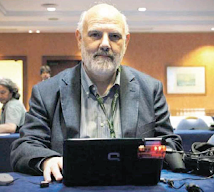
Roberto Maroni is back in the Italian press again today, and with another interview. This interview is in ilResto del Carlino. (Interestingly enough they are running an online poll, and the result was running at 51.7% euro to 48.3% lira). Unfortunately the interview is in Italian. I have translated a few extracts under the fold. The big issue that he draws attention to (and I was flagging this in an earlier post) is the apparent desire of Berlusconi not to commit himself if he can help it.
Essentially Berlusconi has remained silent. No 'the euro is a unique success story' here. I imagine he just couldn't say this in Italy with the electoral base he has (I may of course have to eat my words). To date the only response has come - on his behalf one has to imagine - from Gianfranco Fini, Italy's Prime Minister and foreign minister, who said Maroni's proposal was made 'in a personal capacity' and did not reflect the opinion of the government. Fini said he did not share Maroni's opinion, 'but above all it is certainly not shared by Prime Minister Silvio Berlusconi'.
Maroni's response: that Fini is not a credible 'spokesperson' for Berlusconi. According to Maroni the only opinion that Berlusconi has expressed is that a return to the lira is not possible, not that he wouldn't consider it desireable. The main opinion Berlusconi seems to be expressing is a defence of Italian president Ciampi, who has been attacked by Maroni.
Maroni: Berlusconi ha preso posizione su un presunto attacco a Ciampi che non ha nulla a che vedere con l'euro
Berlusconi has taken a position against a supposed attack on Ciampi, a matter which has nothing to do with the euro.
Interviewer: E stato Fini a dire che il premier ? contrario all ipotesi-lira.
Fini has said that the premier is contrary to the lira hypothesis.
Maroni: Non mi risulta che Fini faccia il portavoce di Berlusconi. E comunque non ? vero. Non ho bisogno degli interpreti per sapere cosa pensi. L'ho sentito questa mattina.
I don't believe that Fini is acting as a spokesperson for Berlusconi. So I don't think it's true. It isn't necessary to go to an interpreter to find out what he is thinking. I heard it (from Berlusconi himself) this morning.
Interviewer: Che cosa le ha detto?
What did he say?
Maroni: Era preoccupato per le reazioni sulla vicenda Ciampi, non per l?euro. Ha detto che secondo lui il ritorno alla lira non si pu? fare, ma non ? che ha aggiunto: perch? lo fate, state sbagliando.
He was worried about the reactions over Ciampi, not about the euro. He said that in his opinion a return to the lira wasn't possible, but he didn't add, if we did it, it would be a mistake.
Italy Economy Real Time Data Charts
Edward Hugh is only able to update this blog from time to time, but he does run a lively Twitter account with plenty of Italy related comment. He also maintains a collection of constantly updated Italy economy charts together with short text updates on a Storify dedicated page Italy - Lost in Stagnation?

Monday, June 06, 2005
Friday, June 03, 2005
Maroni Update
Here's the FT's reading of the situation.
Note this extract: "As financial markets digested the remarks of Roberto Maroni, Italy's welfare minister, the interest rate differential between Italian and German bonds rose to 23 basis points, the widest spread since November 2002."
These are the numbers we will be following at Afoe moving forward. Maroni is a member of a Northern xenophobic party that wants an independent country for the north of Italy. But *note*: he is in the government, and responsible for an important part of the Lisbon agenda, labour reform. So this is not some complete outside crank. Bottom line: Berlusconi's government is an unstable coalation, and this very instability *is* cause for concern, especially since we have just seen mainstream politicians lose important votes in two of Europe's more stable democracies.
Basically I am a great admirer of the late Karl Popper, especially interms of his idea of science as being moved by daring conjectures, and then attempts at refuting them. When I came to the conclusion that demography might be more important for economic theory than it was fashionable to accept today, I tried to set myself an objective, a hypothesis whose confirmation, or absence of it, would help me decide if I was on the right lines.
Japan was already mired in crisis (we are talking about 2001 here), so I asked myself, if you are right what should happen next. Italy should enter a sudden and otherwise relatively unexplicable economic decline was my response. This is why I started the blog, and this is why I have maintained a continuing interest in Italy.
Having said that, I am not a reductionist. Italy's demographic problems form an important backdrop for the present 'embarrasment of difficulties', but of course it is by no means the only factor.
Another stab at what I think is the problem in Italy can be found in this post.
Note this extract: "As financial markets digested the remarks of Roberto Maroni, Italy's welfare minister, the interest rate differential between Italian and German bonds rose to 23 basis points, the widest spread since November 2002."
These are the numbers we will be following at Afoe moving forward. Maroni is a member of a Northern xenophobic party that wants an independent country for the north of Italy. But *note*: he is in the government, and responsible for an important part of the Lisbon agenda, labour reform. So this is not some complete outside crank. Bottom line: Berlusconi's government is an unstable coalation, and this very instability *is* cause for concern, especially since we have just seen mainstream politicians lose important votes in two of Europe's more stable democracies.
Basically I am a great admirer of the late Karl Popper, especially interms of his idea of science as being moved by daring conjectures, and then attempts at refuting them. When I came to the conclusion that demography might be more important for economic theory than it was fashionable to accept today, I tried to set myself an objective, a hypothesis whose confirmation, or absence of it, would help me decide if I was on the right lines.
Japan was already mired in crisis (we are talking about 2001 here), so I asked myself, if you are right what should happen next. Italy should enter a sudden and otherwise relatively unexplicable economic decline was my response. This is why I started the blog, and this is why I have maintained a continuing interest in Italy.
Having said that, I am not a reductionist. Italy's demographic problems form an important backdrop for the present 'embarrasment of difficulties', but of course it is by no means the only factor.
Another stab at what I think is the problem in Italy can be found in this post.
Italian Referendum Call
But in this case the vote would be about Italy's continuing membership of the euro-zone, rather than the EU constitution. Now before going any further, I feel the need to advise extreme caution in the face of such developments.
In the first place the call comes from the Italian Labor Minister - and member of the separatist Liga Del Norte - Robert Maroni: It was made in an interview published by the Italian newspaper La Repubblica. He was not making a statement on behalf of the government, he was in all probability 'electioneering'. (See Fran's post: those politicians).
Apart from the political dimension, it is important to remember that Italy is now in an economic crisis which is every bit as profound, if not more profound, that that being experienced by Germany.
Quickly summarised Italy's problems are:
* What appears to be enduring economic stagnation
* An outdated economic structure (poor product mix)
* Lack of competitiveness and a deteriorating balance of payments
* A currency which is too high to recover competitiveness
* A rate of interest which may be too high
* An extraordinarily poor productivity performance
* Massive and accelerating public debt (over 100% of GDP and rising)
* Europe's most rapidly ageing population
* A noted aversion for accepting immigrants
I will try and flesh this out a little more calmly over the weekend. But in broad brush strokes this is it. Now, vis-a-vis the euro, it is unsurprising that Maroni should choose today to make this statement, since Economics Commissioner Joaquim Almunia has set June 7th 'D' day for initiating a formal excess deficits procedure against Italy and Portugal. As I indicated before the French vote there is every reason to imagine that the new version of the pact will be strictly enforced (this was emphasised by Almunia's presence at yesterday's ECB press conference), especially after the French and Dutch votes and the need to convince everyone that 'the euro *is* a huge success.
Secondly, the ECB yesterday gave no indication of having any inclination of coming to Italy's assistance by lowering the refinance rate.
So it may well be that some Italian politicians can see that it's 'game over'.
Add to this the fact that some people in Italy were extremely relucltant about the euro even on from first day, and you have all the ingredients of an ongoing problem.
Remember too that with elections coming next year, someone may try and make this an election issue.
Background: The following Country Study From Ecfin (may 2005): Italy Stuck In A Rut
Summary
The Italian economy has shown weak growth ever since the beginning of the 1990s. More recently it has developed two particularly striking, interlinked symptoms: a discouraging performance by exports and the longest stagnation of output in the tradable goods sector in post-war history. In contrast to previous episodes of weak growth, the current difficulties are not caused by supply shocks such as excessive wage increases. On the contrary, the dismal export performance has fallen within a period of wage moderation, and, since the late 1990s, of buoyant employment growth. The persistent loss of export market share would seem to chiefly result from the unfavourable product specialisation of the Italian economy ? more recently coupled with a marked slowdown in productivity growth. Italy?s product specialisation, unlike that of countries such as Germany or France, has not significantly changed over past decades in reaction to global economic developments. Italian industry remains strong in traditional, low-skilled labourintensive sectors for which global demand is growing below average. The inertia is generally attributed to a number of structural factors which are hampering change, including low levels of R&D investment, low human capital, low competition ? issues that fall within the remit of the Lisbon strategy.
Also this weeks NTC Research PMI survey: the sharpest deterioration in 41 months in May,
and the OECD's latest economic outlook for Italy.
That's why when Maroni says "We're already heading towards Argentina, that's why we have to change direction," I'm inclined to believe he is in earnest.
In the first place the call comes from the Italian Labor Minister - and member of the separatist Liga Del Norte - Robert Maroni: It was made in an interview published by the Italian newspaper La Repubblica. He was not making a statement on behalf of the government, he was in all probability 'electioneering'. (See Fran's post: those politicians).
Apart from the political dimension, it is important to remember that Italy is now in an economic crisis which is every bit as profound, if not more profound, that that being experienced by Germany.
Quickly summarised Italy's problems are:
* What appears to be enduring economic stagnation
* An outdated economic structure (poor product mix)
* Lack of competitiveness and a deteriorating balance of payments
* A currency which is too high to recover competitiveness
* A rate of interest which may be too high
* An extraordinarily poor productivity performance
* Massive and accelerating public debt (over 100% of GDP and rising)
* Europe's most rapidly ageing population
* A noted aversion for accepting immigrants
I will try and flesh this out a little more calmly over the weekend. But in broad brush strokes this is it. Now, vis-a-vis the euro, it is unsurprising that Maroni should choose today to make this statement, since Economics Commissioner Joaquim Almunia has set June 7th 'D' day for initiating a formal excess deficits procedure against Italy and Portugal. As I indicated before the French vote there is every reason to imagine that the new version of the pact will be strictly enforced (this was emphasised by Almunia's presence at yesterday's ECB press conference), especially after the French and Dutch votes and the need to convince everyone that 'the euro *is* a huge success.
Secondly, the ECB yesterday gave no indication of having any inclination of coming to Italy's assistance by lowering the refinance rate.
So it may well be that some Italian politicians can see that it's 'game over'.
Add to this the fact that some people in Italy were extremely relucltant about the euro even on from first day, and you have all the ingredients of an ongoing problem.
Remember too that with elections coming next year, someone may try and make this an election issue.
Background: The following Country Study From Ecfin (may 2005): Italy Stuck In A Rut
Summary
The Italian economy has shown weak growth ever since the beginning of the 1990s. More recently it has developed two particularly striking, interlinked symptoms: a discouraging performance by exports and the longest stagnation of output in the tradable goods sector in post-war history. In contrast to previous episodes of weak growth, the current difficulties are not caused by supply shocks such as excessive wage increases. On the contrary, the dismal export performance has fallen within a period of wage moderation, and, since the late 1990s, of buoyant employment growth. The persistent loss of export market share would seem to chiefly result from the unfavourable product specialisation of the Italian economy ? more recently coupled with a marked slowdown in productivity growth. Italy?s product specialisation, unlike that of countries such as Germany or France, has not significantly changed over past decades in reaction to global economic developments. Italian industry remains strong in traditional, low-skilled labourintensive sectors for which global demand is growing below average. The inertia is generally attributed to a number of structural factors which are hampering change, including low levels of R&D investment, low human capital, low competition ? issues that fall within the remit of the Lisbon strategy.
Also this weeks NTC Research PMI survey: the sharpest deterioration in 41 months in May,
and the OECD's latest economic outlook for Italy.
That's why when Maroni says "We're already heading towards Argentina, that's why we have to change direction," I'm inclined to believe he is in earnest.
Wednesday, February 25, 2004
Italy's No-Growth Update
OK I'm on a roll, so I'm going to stick my neck out. This slide in the Italian confidence index apparently surprised the 'experts'. Well it shouldn't have surprised Fistful readers who have been following what I have been saying. Clearly these confidence indexes are not the last word in sliced bread. But they do mean something, and Germany's Ifo index just turned in another bad reading too.
Ever since Parmalat, I have been asking one simple question: will Italy ever grow again? Of course, the simple answer is possibly it will: never say never. But will it ever get back to vigorous growth: this I doubt. I am even half asking myself if we will see positive numbers in more than say 50% of the forthcoming quaters. Remember, if my demographic thesis has any predictive power it should be precisely here in Italy that the Titanic starts to take in water. Parmalat was simply the iceberg. Of course my thesis could always be wrong. Any takers?
Ever since Parmalat, I have been asking one simple question: will Italy ever grow again? Of course, the simple answer is possibly it will: never say never. But will it ever get back to vigorous growth: this I doubt. I am even half asking myself if we will see positive numbers in more than say 50% of the forthcoming quaters. Remember, if my demographic thesis has any predictive power it should be precisely here in Italy that the Titanic starts to take in water. Parmalat was simply the iceberg. Of course my thesis could always be wrong. Any takers?
Manufacturers' confidence in Italy suffered a larger-than-expected fall in February, in the latest sign that the economic recovery in Italy and the eurozone as a whole may not be as robust as once hoped.
In a survey released on Wednesday, the Italian research institute ISAE said its seasonally adjusted index of manufacturers' confidence had fallen to 92.6 from a revised 93.5 in January. Financial markets had expected a much smaller decline.
On Tuesday, ISAE reported that its core index of Italian consumer confidence had fallen to 99 in February from 100.6 in January. Consumer confidence is at its lowest levels since the index began in 1996.
The data follow preliminary official estimates of economic growth, according to which the Italian economy ground to a halt in the fourth quarter of 2003 after a brief return to growth in the third quarter. Growth in the whole of 2003 was estimated at 0.4 per cent, the same as in 2002 and slightly below the Italian treasury's expectations of 0.5 per cent.
The latest Italian figures were published one day after the German Ifo institute reported a surprise fall in its closely watched business confidence index, which dropped to 96.4 in February from 97.5 in January. It was the first fall in 10 months.
In a statement, ISAE said the fall in Italian manufacturing confidence had been caused by the stockpiling of finished products, which had returned to a higher level than normal.
Independent economists said the weak Italian data also reflected recent industrial unrest, the financial scandals at the Parmalat and Cirio food groups, and the euro's strength on foreign exchange markets, which is affecting Italian exporters' ability to sell products in the US in particular.
Fear of unemployment, and a perception that inflation is higher than official figures suggest, are other factors behind the low confidence of Italian consumers.
Source: Financial Times
Subscribe to:
Posts (Atom)