Thursday, November 23, 2006

The Future of Young People In Italy


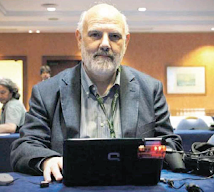
Following up on my earlier post about the problem of graduate out-migration from Italy, Roberto has drawn this Time magazine article to my attention. I really like the photo since somehow it draws attention to that combination of the old and the new which, if people only could find the way to work with it, could serve as a basis for moving things forward in Italy. A nice crisp winter's morning, just like we have in Barcelona today.


Growing up, Italian teenagers learn the tale of Giotto and the fly. As a young apprentice in 13th century Florence, the aspiring painter sketched a fly on the nose of a portrait his master-teacher Cimabue was finishing. So lifelike was the insect that when the elder painter returned to the studio, he repeatedly tried to swat it off the canvas. Realizing he'd been fooled by the bravura talent of his pupil, Cimabue told him: "You have surpassed your teacher." Thus encouraged by his master, Giotto went on to revolutionize Western painting, and posterity regards him as the man who launched the Italian Renaissance.

Fast-forward to Italy 2006, and the image of the precocious apprentice has been replaced by a humbler figure: the underemployed 30-something despondent about the present, let alone the future. Today's Italy is defined by stories like that of Vincenza Lasala. At 32, four years after graduating with honors in mechanical engineering, she is living with her parents in the same house where she grew up. She has sent more than 200 résumés to large corporations and small companies around the country, but all she has managed to secure are a handful of part-time stints, unpaid internships and training programs. From her home in the sleepy southern town of Avellino, near Naples, a frustrated Lasala speaks for much of Italy's younger generation: "Without a job, my parents are basically still in charge of my life. After all my studying, I don't see the fruits of my effort. Right now, I can't even envision my future."

4 comments:

Anonymous said...

I wonder if this mechanical engineer Vincenza Lasala speaks English, at least at a very basic level. After my experience with young Italians, I wouldn't be surprised if the only words that she knows are "OK" and "hello". Maybe this is the reason why so many of them have trouble getting a decent job.

Anonymous said...

Your blog is really interesting to read, Edgar. I studied last academic year in Italy and grew quite curious about what is happening to Belpaese -and regarding that, this blog is certainly among my favourites.

If you haven't read it yet, here's
one article by NY Times of the Italian youth, or rather lack of it.

By the way, can anyone guess how old is the eldest of Italian Senate? Well, quite old.

Anonymous said...

The New York Times is right, aapo, all of Europe has suffered from declining birthrates, but perhaps nowhere has the drop been as profound and prolonged as in some Italian areas (Genoa is only the edge of an iceberg).

Yet, one may find it difficult to understand the following statement:

“Government efforts to reverse the trend are not working. Cash payments for births, for example, have failed to inspire a leap in fertility rates.”

What government efforts was the nyt talking about?
Payments for births? A handful of dust. Ridiculous stuff.

“The new government of Romano Prodi has created a Ministry of Family to address the population problem, but acknowledges that it will be an uphill battle …”

Aknowledgements like this are precisely the reasons why the battle will be an uphill one ...

rob
(Wind Rose Hotel)

Anonymous said...

There is no future for young people in Italy.

Italy At A Glance - January 2008

Welcome to the Italian Economy Watch Blog. Below you will find the normal chronological blog posts. But first we would like to present some charts which provide background data which we hope will help the first time reader better assess and get to grips with the argument being presented on the blog. In what follows you can find charts for Italian male life expectancy, median age, quarterly GDP growth, inflation, household demand, retail sales, and import and exports growth. Basically this data provides a summary of the argument which we are presenting on this blog, which is that in order to understand Italy's long term and ongoing economic malaise you need to understand something about Italian demography, and it's macroeconomic consequences. Please click on thumbnails for better viewing.

On the left you can see a chart for Italian male life expectancy, and on the right there is one showing the evolution of the Italy's median age between 1990 and 2020. Just why such factors are important, and need to be taken into account along with more standard macro economic data in accounting for Italy's stubbornly low growth rate since the mid 1990s is explained in the posts.

With such weak internal consumption growth Italy badly needs to run a trade surplus to obtain the economic growth necessary to make public finances sustainable. In this Italy is similar to Germany and Japan, and different from domestic consumer driven economies like the UK, France and Ireland. Long term fertility and life expectancy really do matter, since they condition labour force growth


and consumption patterns, and with these productivity and the growth of internal credit and consumer demand. Above left you can find Italy's ferility rate, and above right the evolution of the 25 to 49 age group, which has just passed it historic peak. On either side here you can see charts for recent quarterly GDPand long run annual GDP.


Next on the left we have a chart for recent movements in Italian inflation while on the right we can see changes in the trade gap between exports and imports. Inflation is reasonably tamed in Italy (now why?), despite the recent slight uptick, but it is Italy's inability to generate a trade surplus which is the main problem structurally.


Now on the left we have the chart for household consumption and on the right the recent retail sales data. Finally the chart on the bottom left shows recent movements in Italy's business confidence index,while the chart on the right shows the equivalent data for consumer confidence.Bottom line, the evidence of growing weakness is everywhere.

Arguably these are all the data points you need to understand my lengthy post on The Euro Area and Italy's De-Facto Dependence On Exports, as well as why it is that the danger Italy may once more fall into recession presents us with the difficulty of what the credit ratings agencies will say about the resulting impact on the government debt situation.


2008 Forecasts: The OECD in December revised their 2007 Italian forecast down to 1.8%, and the 2008 one down to 1.3%. Confindustria also revised their forecast down in December, arguing that growth would slow to 1 percent in 2008 from an 1.8 percent this year, citing factors like the rising cost of food and oil and the rise of the euro against the dollar. Such numbers are clearly not encouraging, but arguably downside risk for 2008 is greater even than either the OECD or the Confindustria forecasts reflect Morgan Stanley's Vladimir Pillona is somewhat more sanguine. While presenting the MS central forceast for Italian economic growth to slow to 1.0%Y in 2008, from 1.8%Y in 2007, he goes on to note that "even annual GDP growth of 0.5%Y next year has a significant possibility of occurring, as shown by our model’s forecast error bands".

I personally will be very surprised if we still see calendar year 2008 anything like as high as 1.8%, but more to the point even 1.3% may be rather on the high side if we get a significant deterioration in the external environment, especially in Eastern Europe on which Italy is fairly dependent, and where the Italian banking sector has significant exposure. So that puts me much nearer to Pillona's "basement bargain" number of 0.5% than to any of the others. One of the reasons for my pessimism relates to my assessment of Italy's current trend growth rate, and to the level of fiscal and monetary tightening which may be operating on the economy even as it slows. During 2007 the Italian govenment has been running a fiscal deficit of comfortably below the 3% of GDP required by the EU commission. But since this fortunate situation was in part acheieved by the use of one off measures, and in part by the strong tax inflow from the above trend growth, the government will need to maintain a comparatively tight fiscal stance to keep things on course, and any attempt to further loosen may run into real problems with the EU commission and the credit rating agencies. And as I keep arguing, it is very hard to see an accomodative monetary posture from the ECB in the near future. The IMF in their October World Economic Outlook came in with a similar figure of 1.3% for 2008, the Economist Intelligence Unit is forecasting 1.7% in 2007 and 1.4 in 2008, and the latter 2008 figure was also endorsed by the EU commission in its November forecast.

As I indicate, my own view is well to the downside of all this. The only apparent bright spot on the horizon is employment, but I am dubious that in the context of Italy's ageing workforce this will work through as some are hoping, as I expain at some considerable length in this post here. My opinion is that Italy will enter recession at some point during 2008, and that we may well have 2 consecutive quarters of negative growth. The continuing high euro will maintain pressure on Italian exports, and high oil and food prices will maintain pressure on the inflation front, at least in the firts half of 2008. At the same time, and despite rumours that Romano Prodi's government is compemplating a large tax cutting package, I anticipate that the fiscal environment will remain tight. Italy's large (106% GDP) accumulated debt, and the vigilance from the gentlmen at Standard and Poor's and the other credit rating agencies more or less guarantee that.

As most of the forecasts suggest, we have been seeing growth which is somewhat above trend during the upswing in the last couple of years, so it would not be surprising if we now saw some below trend growth. Trend growth (over a 5 year average) in Italy may even have fallen into the 0.5 to 1% range, so if I have to put a number I would say 0.7% with a definite "downside risk" tag attached. The nearest forecast to this that I have seen is the 1% one from the Morgan Stanley GEF team. The implications of such sustained low growth are, I think, important, since if Italy cannot find the way to raise trend growth up towards the 2% mark there is simply no way the government debt can be stabilised and sustained. And with each passing year we have one year less to crunch time.